
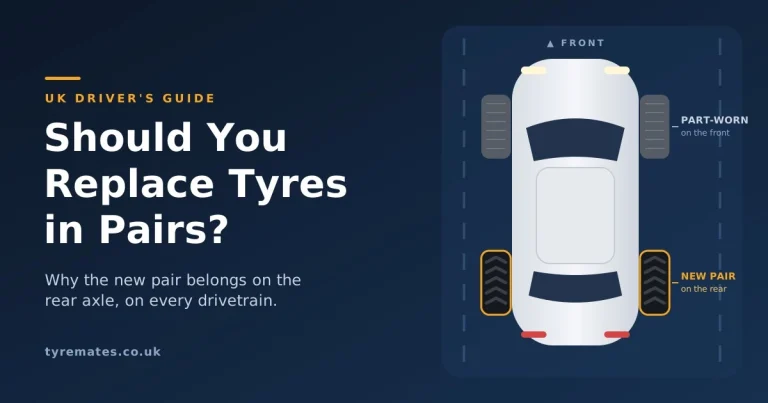
Yes tyres should be replaced in pairs on the same axle, so both sides share the same grip, tread depth and rolling resistance. The one exception is a single tyre whose axle partner is close to new and matches it on size, load index, speed rating and tread pattern. When you buy only two new tyres, they go on the rear axle, whether the car is front-, rear- or four-wheel drive. Many 4×4 and AWD cars go further and need all four tyres closely matched to protect the drivetrain.
Why two matching tyres matter more than you think
A worn tyre and a fresh one on the same axle behave like two different cars bolted together. They grip at different levels, roll at slightly different rates and clear water at different speeds. On the road that shows up as steering pull, a car that veers under hard braking, and one side aquaplaning before the other. ABS and stability control judge grip by comparing wheel speeds, so an uneven pair can trip them into reacting when they shouldn’t.
The tread gap is not a small detail. According to Kwik Fit’s 2018 tests at MIRA, wet braking was 15–30% better on 7mm of tread than on 2mm, across eight brands from small cars to SUVs.
When replacing just one tyre is fine
If one tyre is damaged and its partner still has most of its tread, a single replacement is reasonable. Kwik Fit’s guidance draws the line at 3mm: if the remaining tyre on that axle has 3mm or less, replace both. The new tyre should match the old one exactly on size, load index, speed rating and tread pattern.
Before buying anything, check whether the tyre can be saved. Industry repair guidelines allow punctures up to 6mm in the central tread area to be repaired, while sidewall or shoulder damage never can be. Our Punture repair page.
New tyres always go on the rear here's why
Michelin UK’s technical manager, Brian Porteous, told Auto Express in 2024 that around half of UK drivers fit their new pair to the wrong axle. Deeper tread belongs at the back. If the rear tyres let go first, the car oversteers: the back steps out and a spin is hard to catch. If the fronts let go first, you get understeer, which most drivers recover from simply by easing off.
Pirelli’s 2020 product guide and Michelin’s 2019 professional guide, both cited by Kwik Fit, give the same instruction, and it applies to front-wheel drive, rear-wheel drive and 4×4 alike. Kwik Fit notes two exceptions: cars with staggered front and rear sizes, and cars running directional tyres on the front with asymmetric tyres on the rear.
Front-wheel drive vs rear-wheel drive: does it change the rule?
No. Buy tyres as a pair for whichever axle needs them, and if you are only buying two, they still go on the back. Drivers ask because the front tyres on a front-wheel-drive car do the steering, most of the braking and all of the driving, so they wear out first. The right move is to bring the better rear tyres forward and fit the new pair behind them.
Mixing tyres: brands, patterns and sizes
Across a single axle, keep brand, tread pattern, size and construction identical. Different compounds and tread designs grip differently, even when the sizes match. Seasonal tyres follow the same logic: Continental’s UK and Ireland technical bulletin says no UK regulation prevents mixing seasons, and all-season tyres can sit alongside summer or winter tyres in axle pairs, although full sets are preferred. Winter tyres perform best fitted as a set of four.
Tread depth: the numbers that matter
1.6mm is the legal floor, not a sensible target. Manufacturers and Kwik Fit recommend changing at 3mm, because UK roads are wet so often and aquaplaning risk climbs as grooves get shallower. National Highways guidance, reported by carwow, puts good practice at 2mm in summer and 3mm in winter.
For a quick check, push a 20p coin into the main grooves; if the outer band stays visible, have the tread measured properly. Age counts too. Michelin advises a professional inspection once tyres have been in use for five years, and replacement ten years after manufacture, which you can read from the DOT code on the sidewall.
Replacing a pair in Coventry
Tyre Mates fits tyres at your home, workplace or roadside across Coventry and nearby areas. Book through our mobile tyre fitting service or call or send your tyre size through Whatsapp.
Frequently Asked Questions
Should you replace tyres in pairs?
Yes, in most cases. The two tyres on an axle should share the same tread depth, pattern and specification so the car stays balanced when it brakes and corners. A mismatched pair can pull the steering sideways and stretch wet stopping distances. The main exception is when the tyre opposite is almost new.
Can I replace just one tyre in the UK?
Yes. Nothing in UK law stops you fitting a single tyre, and it makes sense when the one opposite still has deep tread. Kwik Fit’s rule of thumb is to change both once the remaining tyre is down to 3mm. The replacement must match on size, load index, speed rating and pattern.
Should new tyres go on the front or back?
The back, on every type of drivetrain. Fresh tread at the rear keeps the back of the car planted, so if grip runs out in the wet, the front slides first and the car is easier to bring back under control. It feels counterintuitive on a front-wheel-drive car, but tyre manufacturers agree on it.
Do I need to replace all four tyres at once?
Not usually on a two-wheel-drive car. Replacing one axle at a time is normal and safe, provided each pair matches. Four at once makes sense when all four are worn to a similar depth, when you’re switching to winter or all-season tyres, or when an AWD manufacturer requires matched tread.
Can I mix different tyre brands on the same axle and is it an MOT fail?
It’s best avoided, because each brand uses its own rubber compound and tread design. A brand mix on its own isn’t an MOT failure, though. Under the GOV.UK MOT inspection manual, the failures are different sizes on the same axle, or radial-ply and cross-ply tyres mixed on one axle.
What is the legal minimum tread depth in the UK?
1.6mm, across the central three-quarters of the tread and around the whole tyre. That figure is a legal limit rather than a safe one. Most tyre makers suggest replacing at 3mm, because braking in the wet gets noticeably worse as the grooves wear shallower.


